The 8 of Swords

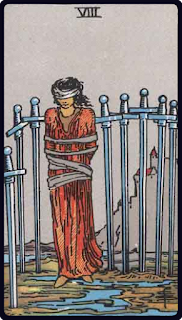
The 8 of Swords - Tarot Card from the Rider-Waite Deck

Representing urgency; the 8 of Swords represents the loss of peace and tranquillity, replaced with disturbance once more but with much greater urgency. The 8 of Swords is a sign of trial and tribulation and the need for strength of spirit to endure the return of conflict, with a particular emphasis on course correction where our forward path has not led where we intended it to lead.

In the upright state the 8 of Swords emphasises the need for diplomacy, the impetus to communicate clearly is amplified; the death of our identity as a means to achieve stability as portended by the 4 of Swords makes a return two-fold with the permanent closure of conflict predicted; in the upright state this closure is likely to be positive.

In the inverted state the 8 of Swords warns that the return of conflict is likely to result in defeat which portends to a breakdown of communication and the return of conflict this time beyond resolution, instead an existential threat is posed where the victor will remain, and the defeated element will be removed entirely.

The 7 of Swords

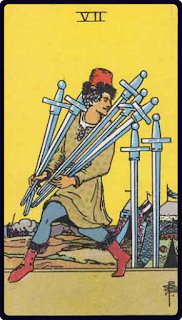
The 7 of Swords - Tarot Card from the Rider-Waite Deck

Representing reinvention; the 7 of Swords is associated with the potential for renewal and redevelopment. The potential for growth is emphasised here and the path forward is filled with hope and optimism.

In the upright state the 7 of Swords represents counsel and prompts us to embrace the concept of reconciliation and focus on the potential to build something new that goes beyond what existed before. Where the 6 of Swords incorporated reconciliation as the outcome of conflict resolution and closure, the 7 of Swords focuses particularly on ambition and aspiration for the future, and the implementation of ideas that can bring us closer to that future.

In the inverted state the 7 of Swords is a warning that old conflicts could be renewed once more and a return to disturbance may be approaching. Where the 6 of Swords warned of stagnation as the consequence of our failure to gain closure, here the emphasis is placed on the potential of further hurt from wounds that remain open.

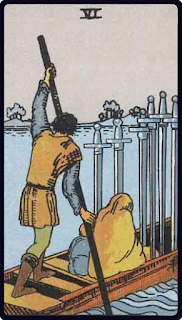
The 6 of Swords

The 6 of Swords - Tarot Card from the Rider-Waite Deck

Representing transience and movement; the 6 of Swords is associated with endurance and consequence. In the wake of conflict reality persists, life goes on and the impact and legacy of that conflict endures despite the cessation. Long after the conflict itself is forgotten to history the impact will still be felt even if the significance and the origin is not understood by those who endure.

In the upright state the 6 of Swords represents our need to accept and move beyond conflict. To accept the past as written, something we cannot change, but to embrace the present as an opportunity to shape the future and decide upon the direction of travel both in how we view our past and how we let it shape our future. We may not be able to change what has happened but we can choose how we respond to the past, and the mindset we wish to adopt going forward. Holding onto past conflicts perpetuate their negative influences, whilst drawing a line under them gives us the opportunity to reach new destinations.

In the inverted state the 6 of Swords explicitly represents this loss of potential when we hold on to conflict, whilst no longer engaging in that conflict it still governs our thoughts and informs our actions and ultimately controls our lives. The inverted 6 of Swords therefore emphasises the need to seek closure in order to overcome our inability to let go and to move forward. Where the upright state looks forward and emphasises optimism, the inverted state looks backward emphasises our need for closure.

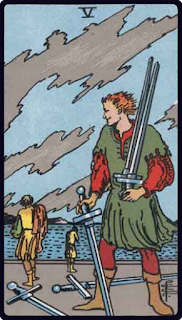
The 5 of Swords

The 5 of Swords - Tarot Card from the Rider-Waite Deck

Representing conflict; the 5 of Swords relates to the concepts of arrogance and condescension. Tolerance of different beliefs and thought processes deliver harmony and peace, intolerance inflames conflict and leads to disruption and disturbance.

In the upright state the 5 of Swords asks us to be mindful of perspective and to regard the truth that no-one believes themselves to be the villain and embraces this identity in conflict beyond depictions for entertainment value. In all other conflicts both sides believe themselves to be just and true; when attempting to resolve conflict be mindful that you are the protagonist in your own story, but you are the antagonist in that of your opponent.

In the inverted state the 5 of Swords emphasises the futility of war and the assertion that conflict never leads to victory but to mutual loss. This assertion prompts us to consider what we are willing to lose for the sake of our righteousness and whether that sacrifice is one we are willing to make.

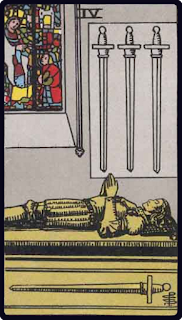
The 4 of Swords

The 4 of Swords - Tarot Card from the Rider-Waite Deck

Representing stability; the 4 of Swords is associated with a moment of transition from an unstable counterproductive mindset to the emergence of productivity and optimism. Where this relates to positive thought this represents the pragmatic mind prevailing, a practical focus and direction emerges. Where this relates to negative thoughts this portends the end of our spiral downward, the deepest point in our despair is reached, from here the only direction of travel is upward, whilst in the absence of transience we will remain at this nadir.

In the upright state the 4 of Swords promises stability if we embrace this new way of thinking revealed to us through introspection and understanding of the self. By letting go of the identity of failure and associating ourselves with the identity of success we create the foundation needed to build upon, we create solid ground upon which to stand.

In the inverted state the 4 of Swords represents the end of the thought process and the death of idea. The triple force of self- doubt wins out in the end. This portends the release or resignation of an idea as fantasy, not just the end of our attempts to achieve but also the acceptance that we never will.

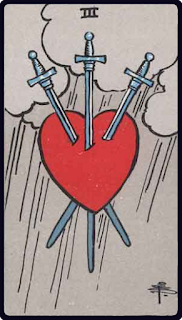
The 3 of Swords

The 3 of Swords - Tarot Card from the Rider-Waite Deck

Representing connection; the 3 of Swords is associated with our attempts to look inward in the pursuit of understanding. This aligns most closely with the idea of self-criticism, through which the 3 of Swords represents the risk posed to us by doubt and insecurity or unchecked anxiety.

In the upright state the 3 of Swords is a warning that our own lack of ambition, lack of faith in our ability, and our own insecurity collectively serve as the barriers that hold us in place. If we do not overcome our self-doubt, we will never realise our potential. Imposter Syndrome is the belief that others know more than they actually know, and the act of discrediting what we know diminishing its significance resulting in the belief that we do not belong where others do. The 3 of Swords represents our internal state disturbed by this feeling.

In the inverted state the 3 of Swords represents this disconnection between our introspection and self-criticism. The difference between criticism and critique is such that the former, criticism, destroys with no other intention, the latter, critique, deconstructs in an attempt to rebuild with greater strength, an act we associate mostly with the idea of a mentor or external source of validation that attempts to mould our thoughts.

The 2 of Swords

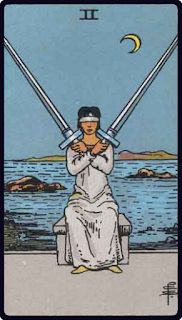
The 2 of Swords - Tarot Card from the Rider-Waite Deck

Representing balance; the 2 of Swords takes the idea of balance between knowledge and experience and attempts to implement balance through blindness. The 2 of Swords therefore represents trial and error, our attempt to practice and learn and acquire new knowledge and experience in the absence of prior knowledge or prior experience.

In the upright state the 2 of Swords represents the need to act, no matter what we want to achieve we need to put theory into practice before anything of substance can be created. Without action we cannot gain experience. Where this focus is on positive thoughts and desires, the prompt is to take action no matter how significant that action may seem, you must take at least one step to bring you closer to your desire. Where this focus is on negative desires or fears, the prompt again further underlines the warning not to dismiss negative influences and remain complacent, you must confront them as their power and influence is already growing.

In the inverted state the 2 of Swords represents an imbalance between knowledge and experience, it could portend to a fixation on one element without attention being paid to the other – acting without understanding, or understanding but never putting into practice. Where this relates to our fears and anxieties the inverted 2 of Swords is a warning not to forget context, not to focus on your fear without framing it in the context that it originates.