The Queen of Wands

The Queen of Wands - Tarot Card from the Rider-Waite Deck

Representing the maternal nature; the Queen of Wands represents our instinct to nurture others and protect them. Where the Knight of Wands represents the position of authority gained through wisdom that has been attained, the Queen of Wands represents a position of authority gained from obligation and devotion. A Squire, or Page in medieval times served a Knight by choice in recognition of their status, a child however is bound to its mother by birth, beyond choice this connection can never be broken.

In the upright state the Queen of Wands represents our attention turning away from what we have created, instead focusing on the act of bestowing this creativity on others. The Queen is outward looking, forward thinking, and proactive in her nature.

In the inverted state the Queen of Wands represents our attention turned inward, reflecting upon our strengths and weaknesses in an attempt to recognise the limitations of our power and influence. Knowing what we are capable of allows us to have the greatest impact that we can.

The Knight of Wands

The Knight of Wands - Tarot Card from the Rider-Waite Deck

Representing discipline; the Knight of Wands represents the application of knowledge, and the combination of knowledge and experience which together produce wisdom. The Knight of Wands emphasises iteration and evolution, and the effort to guide others who would seek to follow in their footsteps.

In the upright state the Knight of Wands represents the embodiment of wisdom and the utility of our creative output. Skill, development, and training, are the focus for the Knight of Wands and serve as our prompt not to abandon our creative achievements upon completion, but to continue to use them and find utility within them. If ever there was a card to represent the call to recycle past creations, it would be the Knight of Wands.

In the inverted state the Knight of Wands represents the shortcomings of what we have created, the awareness of limitation in application. Whilst the creative process is objectively complete, the evolution of the creative output is not. What we have created can serve as the foundation of future creative endeavours that serve to iterate over our designs.

In the Rider-Waite deck the Knight of Wands rides on a horse wearing a yellow robe adorned with reptilian creatures; the symbolism of these creatures reflects the Reptilian Brain which is said to be driven by repetition and ritual, spurred on by instinct and impulse with emotional desires and their influence minimised. The reptiles depicted on their robes attempt to eat their own tails, an act which if achieved would create an Ouroboros, a symbol of reiteration and recursion, representing the evolution of the creative process.

Finally, three pyramids can be seen in the distance behind them representing the material essence or legacy of the creative process; our creative output will often persist and the utility therein may be found and adopted by generations to come.

In self-reflection the Knight of Wands serves as a prompt to consider the sources of wisdom and knowledge at your disposal and the example they set for you to follow. This is an opportunity to look to those who have already achieved what you seek and reflect on how they did it and identify the routine and mannerisms needed to do the same for yourself.

At this point you have gained your own experience, no longer the amateur, you stand aside those of achievement, treat them as equals and exchange your ideas. Recognise the strengths you have identified and the weaknesses you that have held you back or constrained your vision. Ask yourself “What do I need to work on?” and “What did they do differently?” when comparing your outcome to others, identify what you can learn from their experience to combine with your own.
The Page of Wands

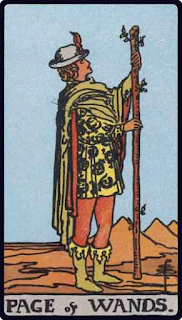
The Page of Wands - Tarot Card from the Rider-Waite Deck

Representing study; the Page of Wands represents our attempts to research, reflect, and understand what has been achieved, what can be learned, and how we can plan for the future.

In the upright state the Page of Wands asks us to look back objectively at what we have created and reflect on the process as a whole, to consider what can be learned. We are asked to consider if we were to undertake such an endeavour again what would we do differently and what would we do the same.

In the inverted state the focus shifts from our creative process to the creative output itself. Instead of examining the means of production we examine the product. We are asked to be objective once more and consider what we have produced and whether it has merit or value, what flaws does it contain and what perfections.

The 10 of Wands

The 10 of Wands - Tarot Card from the Rider-Waite Deck

Representing completion; the 10 of Wands represents the reaping of reward. Our efforts are complete, the final element has been acquired, and our creative endeavour yields the rewards we sought. The number 10 represents a return to parity, and the restoration of stability, calmness, and clarity of mind.

In the upright state the 10 of Wands prompts us to take the opportunity to enjoy the fruits of our labour. The path is complete, the investment returned, and our enjoyment of the moment is our focus.

In the inverted state the 10 of Wands represents disappointment and criticism, and our inability to recognise when to stop. Our job is complete yet we may not feel this to be the case, we may still feel there is more we could do and more we could achieve particularly if we fail to recognise the original vision, we set out to realise because it does not look exactly as we had imagined; the 10 of Wands in the inverted state asks us to consider the inability to resolve these lingering elements as new journeys, not as part of this endeavour. Draw a line under what has been achieved, and if your vision has expanded then consider your new perspective as a separate journey for which the present serves as inspiration.

The 9 of Wands

The 9 of Wands - Tarot Card from the Rider-Waite Deck

Representing anticipation; with the investment already made the 9 of Wands represents our anticipation of fulfilment and reward for the efforts we have made. Parity is disturbed with this odd numbered card and balance is sought, the arrival of a new element to restore parity is the focus here.

In the upright state the 9 of Wands represents vigilance and the counsel to remain observant; although we may perceive that the hard work has already been done and that our path should be simple going forward, we are advised to maintain our work ethic not to rest on our laurels until we see our efforts through to completion.

In the inverted state the 9 of Wands represents patience and the need to maintain composure. Whilst we wait for the element of completion, we must maintain what we have created so far. Where the upright state emphasises the need to continue seeking opportunity to move forward, our focus in the inverted state is to defend against elements that could derail or undermine the progress made so far, this is not an act of stagnation as it is not an idle effort, but rather one that will require a lot of energy to maintain what has been achieved. For example, when we reach our fitness goals, to abandon the routine of exercise will erode the gains we have made, maintenance is essential to preserve what we have achieved, even if we make no effort to go beyond that achievement.

The 8 of Wands

The 8 of Wands - Tarot Card from the Rider-Waite Deck

Representing urgency; the 8 of Wands is a card that prompts us once again to return to momentum and forward motion. The restoration of parity brings forth a renewal of effort in our approach. Where the 7 of Wands represents our moment of respite and reflection, the 8 of Wands is our prompt not to lose ourselves in nostalgia and the narcissism found in the act of admiration of our past endeavours.

In the upright state the 8 of Wands is a sign to move on, you already possess all that you need within yourself to achieve your goal, or all that can be achieved at this point, maintaining momentum is essential as the only true failure is the failure to try. Even if you doubt your abilities, the act of creation in itself will feed creativity in turn, just as you rise from slumber and stupor, your consciousness elevates and your awareness grows the more effort you put into creating movement.

In the inverted state the 8 of Wands represents sudden change; where the upright state focuses on the internal state and how it relates to the wider world, the inverted state focuses on the wider world as an external factor and how it influences our internal state. This sudden change will impact our creative process and we will need to move beyond it in order to maintain momentum.

The 7 of Wands

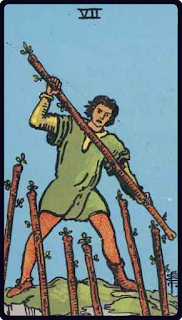
The 7 of Wands - Tarot Card from the Rider-Waite Deck

Representing reinvention; the 7 of Wands represents our need to adapt and be flexible in our approach. No human is blessed with a foresight that can foresee every eventuality, it is an inevitability that new information will come to light, new experiences will be had, and new wisdom will be gained as we walk through our path in life. To hold onto the plans that we created in the beginning with rigidity is to deny the value of this experience and prevent ourselves from evolving as spiritual beings.

In the upright state the 7 of Wands asks us to consider a change in our approach, it does not necessarily require us to start over from scratch but rather to take our original vision and revisit it with fresh eyes, knowing now what we have learned. We often say to ourselves “If I knew then what I know now” in reference to the decisions we made in our past, with these words often spoken in the shadow of regret but we forget to remind ourselves that the commitments we once made that we still hold onto are not only a memory they are a legacy, whether we are still bound by that legacy is a choice, albeit one that may be difficult to change. Regardless, to embrace our growth we need to be able to accept that our priorities shift, our vision clarifies, and our direction can and often will change.

In the inverted state the 7 of Wands asks us to consider what has been built so far, and revaluate whether or not we have met our original vision by a different interpretation. For example, if we set out with the desire to write a book but never manage to achieve this goal explicitly, but in the process write enough content that could fill a book, reconsider whether your objective was in fact met, in other words, consider whether you have written more than the measure of a book in your mind even if you never decided to publish it in the end. It is often the rigidity of our vision that determines our failure rather than reality.